For immediate release
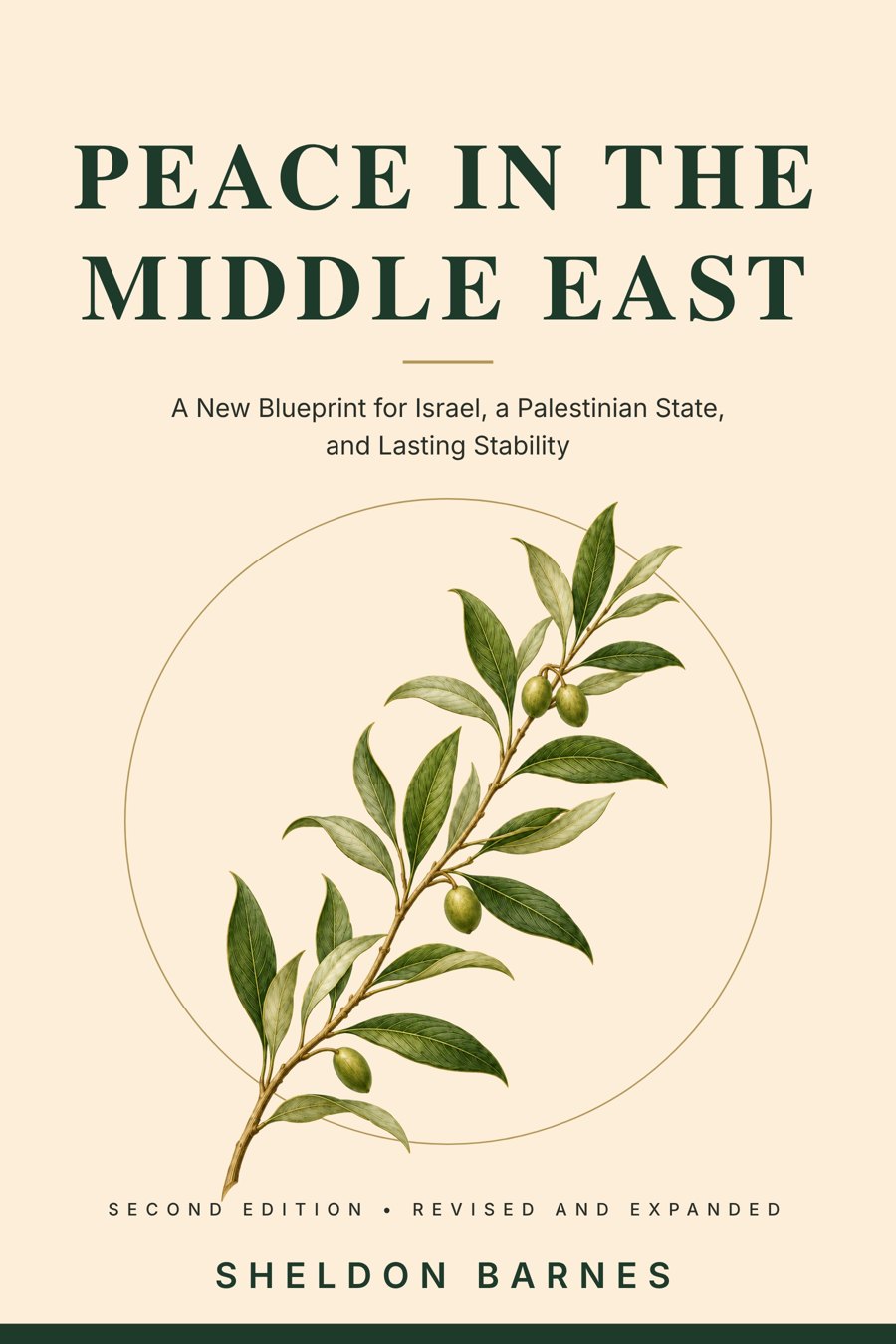
“Peace in the Middle East” — second edition, out November 16, 2026
A new blueprint for Israel, a Palestinian state, and lasting stability — rewritten after the war with Iran, the elections in Washington and Jerusalem, and a blockade that is still in force.
The second edition of Peace in the Middle East: A New Blueprint for Israel, a Palestinian State, and Lasting Stability will be released on Monday, November 16, 2026 in paperback, hardcover, and Kindle.
This is not a reprint. The first edition, published in April 2026, was written before the war with Iran began. Every chapter of this edition has been revised in light of what followed, and the book has grown by a full chapter and three appendices. Its research cutoff is November 8, 2026 — eight days before it goes on sale.
Why now
The region that exists today is not the region the first edition described. The Strait of Hormuz is in dispute. The Islamabad Memorandum was signed. The Lebanon front reopened and the Gaza ceasefire froze in place. Voters in the United States and in Israel went to the polls and changed the governments that will have to live with the result. A blockade remains in force as this book goes to press, and impeachment proceedings against the Secretary of Defense are moving in Congress.
Every one of those events is an argument for the book's central claim: that the problem is structural, not personal. Governments change. The system that produces this war does not — unless someone redesigns it.
“Confronting Iran was not enough,” Barnes writes in the new chapter. “Peace is not out of reach. But it will not happen by accident. It must be designed.”
What's new in the second edition
- A full chapter — “Confronting Iran Was Not Enough” — on the 2026 war, from the closing of Hormuz to the Islamabad Memorandum, the Lebanon front, the frozen Gaza ceasefire, and the American election that followed, ending with a pillar-by-pillar verdict on what the war did and what it skipped.
- An implementation playbook on a single calendar: who acts, under what authority, at what cost, and what happens if a step fails.
- The Palestinian political track in detail — an inclusive voter register, a referendum with separate questions on the constitution, the transitional authority, and the security mandate, and a humanitarian floor no penalty can touch.
- A dated timeline from October 7, 2023 to November 8, 2026, a glossary, and an implementation matrix, with sources rechecked and the limits of that checking stated plainly.
About the book
Peace in the Middle East is not another history of grievance or another partisan argument. It is a systems-level blueprint that explains why so many peace efforts have stalled, what the treaties that held got right, and what it would take to build something that lasts.
It introduces four frameworks for reading the conflict — the 3D World, the 5D Reality, the 3HI Proxy Network, and the Octopus Doctrine — and then uses them to build one concrete proposal: the Gulf-to-Gulf Accord, resting on five pillars that have to stand at the same time. A regional security compact with real enforcement. Disarmament in Lebanon, Gaza, Yemen, and Iraq at once. A standing offer to Iran. A Palestinian state inside the compact rather than outside it. And a prosperity engine no one can hold hostage.
Sheldon Barnes served in Iraq. In the years after he came home, he watched the war he had been part of reshape the region in ways no one could see from inside it. This book is his effort to make that service mean something.
For readers who are tired of cynicism but unwilling to settle for slogans.
The details
Second edition, revised and expanded • 336 pages • 6 x 9 inches
Paperback, hardcover, and Kindle
On sale November 16, 2026
peaceinthemiddleeastbook.com
Press
Review copies, interviews, speaking, and excerpt permission: message the author on LinkedIn, or write to sheldonbarnes@gmail.com. Cover images and the book description are available on request.
###